Body Weight and Body Shape: What You Need to Know


We talk about weights and bodies constantly – but what do we really need to know?
Popular diets, generalized public health messages, and even our friends and family have lots to say about weight and body sizes. But do they really address the full picture of health, physical performance, and body composition? Here are 3 things you may not know about your body weight.
Body composition matters more than total weight.
The number on the scale tells us the total weight of your skin, bones, organs, water, muscle, and fat. Some of these components of our body are, admittedly, much easier to change; But we still must remember they are all accounted for on the scale.
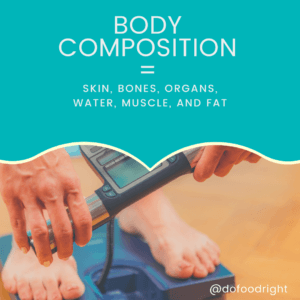
Body composition = skin, bones, organs, water, muscle, and fat
Frame size is used to talk about the natural size of someone’s skeleton. This is not something we can change but is important in understanding our body shape and size.1 Water in our body depends on our hydration, sodium intake, hormones,2 and swelling. Skeletal muscle is very adaptable tissue that is in a constant state of building and breaking down. Through resistance exercise in combination with eating enough food your muscle has what it needs to grow.
Fat is what we usually associate with weight gain because public health messages are generally targeted at obesity and losing body fat. While we do need to keep our body fat in check, we need fat for protection of organs and bones and insulation so we’re not losing too much heat. Not to mention, much of our brain and neurons are made of fat! Fat has a crucial role in the function of hormones as well.
So, before we jump to the conclusion that weight loss is always a good thing, we have to decide what the composition of the weight is and create a strategy for managing each of the components so we’re not inadvertently putting ourselves in a worse place for health.
Body mass index, or BMI, is a ratio of your height to weight.
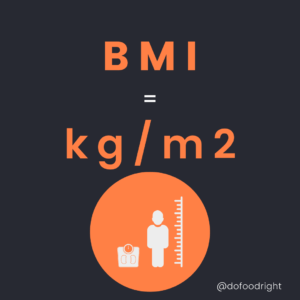
Even though it is talked about like it is a diagnosis (“your BMI is 35.0 so you are in the obese category”), it is meant to be a screening for body fat and risk, not a diagnosis.3 What is the difference? A screening captures those potentially at risk for disease concern while a diagnosis can only happen after more assessment. How are your other vitals and your energy level? Where is your weight distributed (belly versus breasts, legs, butt)? How much muscle do you have compared to fat?
Only after we take the whole picture of “you” into consideration can we decide if excess fat is putting you at greater risk for disease. I like to measure fat mass as percentage of total body mass because that tells us way more about your health than simply knowing your BMI.
Fluid is likely to be the reason your weight goes up and down day to day (as opposed to fat gain and loss).
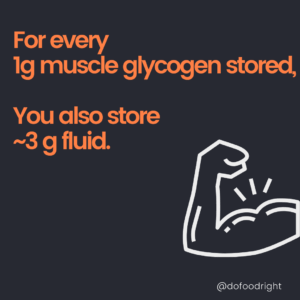
In fact, I recommend against weighing yourself more often than weekly – and for most people even that is unnecessary! Glycogen, or carbohydrate stored in the muscle and liver, is used during exercise to fuel muscles and to keep our blood sugars from dropping. When we are limiting carbohydrate or total calories, our glycogen stores are low. When we eat or drink carb (along with enough total calories), our muscle and liver is replenished with energy storage. How does this matter in a conversation about fluid? Well, each gram of glycogen stores about 3 grams of fluid along with it. The body can store around 440 grams of glycogen4 (just under 1 pound) so that means we may have around 1320 grams of fluid stored with it – an extra 3 pounds of weight just from fluid. Aside from glycogen, we also have to keep in mind that sodium from our food and beverages causes fluid retention.
For me to make a sweeping generalization about your weight, fluid, sodium, or glycogen and what it “should be” would be borderline unethical – we have to DO FOOD RIGHT, meaning we have to apply everything we know about biology and physiology and apply it to YOU as an individual.
So what should you really do?
Know your body! Use multiple signs of health and wellness before deciding that the number on the scale needs to change. Learn what habits make your body functions best and DO THAT. Understanding the trends in your body composition and physical performance can be a much better tool to determine if your nutrition and fitness plans need a change – you are more than just a number!
Resources:
- Henneberg M, Ulijaszek SJ. Body frame dimensions are related to obesity and fatness: Lean trunk size, skinfolds, and body mass index. American Journal of Human Biology. 2010;22(1):83-91. doi:10.1002/ajhb.20957
- Stachenfeld NS. Sex Hormone Effects on Body Fluid Regulation. Exerc Sport Sci Rev. 2008;36(3):152-159. doi:10.1097/JES.0b013e31817be928
- Body Mass Index: Considerations for Practitioners. :4.
- Benardot D. Advanced Sports Nutrition. 2nd ed. Human Kinetics; 2012.

The One You Nutrition team believes food is nourishment, medicine and fuel. That belief drives our passion for nutrition and energizes us to share our expertise in Wellness, Sports Nutrition and Obesity & Weight Management to improve the lives of our clients. As the food expert on your team, we coach you to set your ultimate vision of success, plan action steps, embrace strengths, improve weaknesses and master the skills to Do Food Right™.
Do You Feel like You’re Doing Food Wrong?
CHECK OUT OUR FREE GUIDE!
There is so much nutrition information out there that it’s impossible to know where to start. We’ve simplified the message with 5 tips which we believe are applicable to everyone

5 ways to “Up” your (healthy) pizza game

6 Things to Include in Your Food Journal